
Your Business Has a Life of Its Own
The roles are clear. The meetings are happening. The numbers look okay. And still, people hold back, decisions keep circling back to you, or the business feels strangely flat.
That tension is a signal. It may not point to one broken process or one difficult person. It may be telling you that the parts of the business are no longer working together in the way they need to.
The same is true when you're looking ahead—before you grow, hire, or hand off more responsibility. The question isn't just what to change. It's how the whole system will respond.
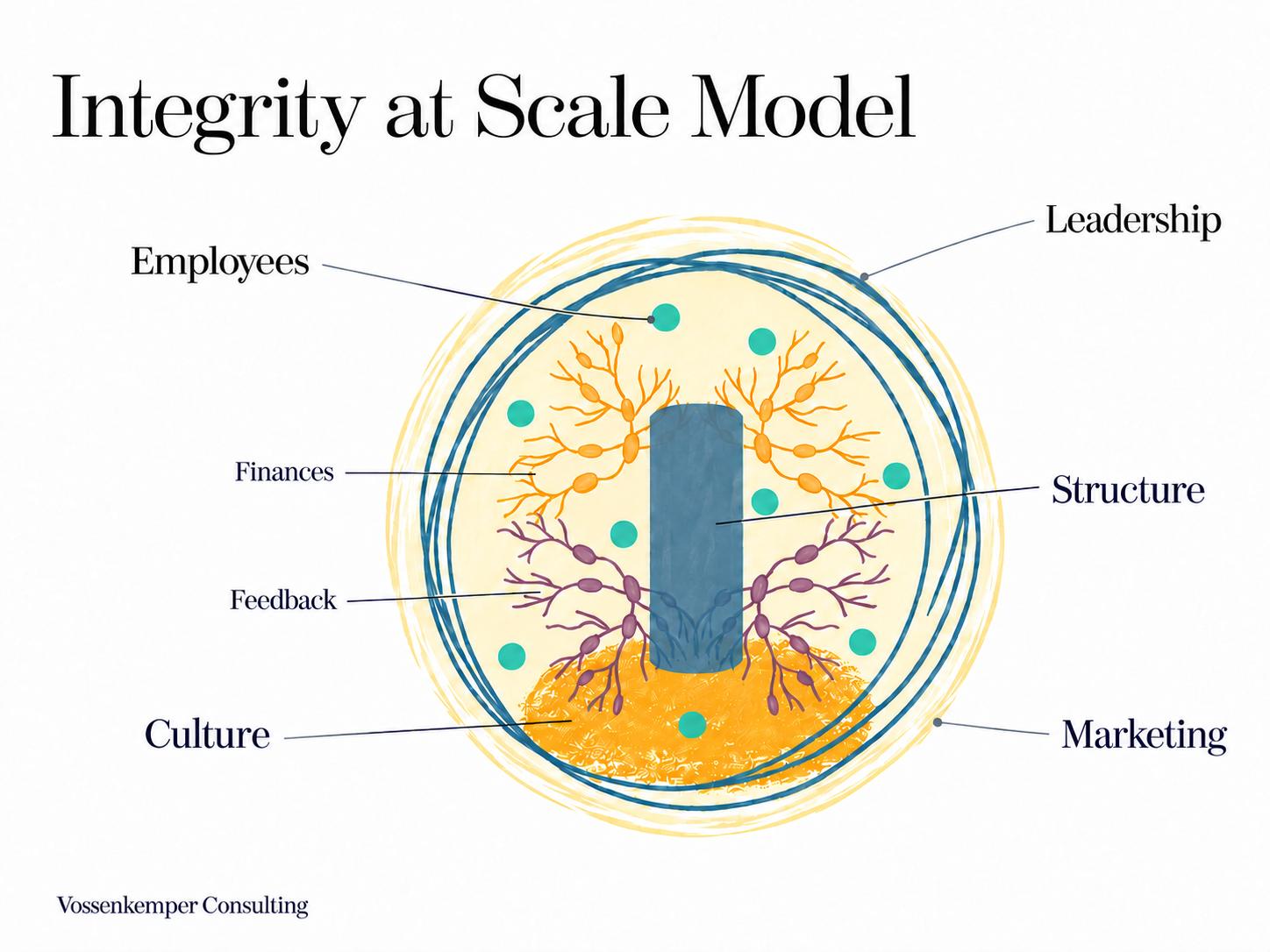
Integrity at Scale™ is a model for understanding and leading organizations as living, interdependent systems. It helps leaders see how leadership, employees, structure, culture, and marketing shape one another, then create the conditions that allow the organization to sustain its work, support its people, and adapt as complexity increases.
What Integrity Means as the Business Changes
Integrity means the parts of the business work together and support what it stands for. What you promise, what you reward, how decisions get made, and what people experience need to fit together.
If you value autonomy, people need real decision authority. If you want to pay people well, the business needs a way to sustain that commitment. If you invite honest feedback, people need to trust that they can speak up and be heard.
Scale is the complexity the organization needs to hold: more people, more decisions, more relationships, or more responsibility moving beyond you. The model is useful when you're growing, changing your role, or helping the business you already have work better.
Five Components That Shape One Another
Each part affects the others. The model helps you look at those relationships and notice where the business needs attention.
Leadership
Leadership is the porous membrane containing the organism. It shapes direction, boundaries, and the way the business responds to pressure. What you let in, what you let out, what you tolerate, and how you handle difficult information all affect the people inside it.
Employees
Employees are the interactive orbs moving throughout the organism, bringing judgment, energy, relationships, and work to everything they touch. They're continually responding to its conditions and shaping them. Their fit, capacity, and ability to contribute deserve attention alongside the roles they're filling.
Structure
Structure is the organism's central spine. It gives people a clear way to work: who owns what, who can decide, how priorities get translated into action, and how work moves between people.
Two substructures within Structure help the whole organization sustain itself and respond:
Finances are the organism's circulatory flow, carrying the resources that make the work possible. Pay, pricing, cash flow, and investment decisions affect what the business and its people can carry.
Feedback is the organism's sensory network, carrying information that helps it notice and respond. Numbers, conversations, behavior, and recurring patterns become signals the business can use to learn and adjust.
Culture
Culture is the very foundation on which the organism is built and experienced. It's shaped by repeated decisions and interactions: what gets rewarded, what gets tolerated, how conflict is handled, and what happens when someone raises a concern.
Marketing
Marketing is the energy radiating from the organism, shown as the light around it. Its message, reputation, and invitations should reflect what's accurate and true about the organism while also shaping what clients, employees, and other people expect to encounter. That expectation should fit the organization they're actually entering.
Use the Model on a Real Situation
If decisions keep coming back to you, the model gives you several places to look:
Do people know what they can decide and what needs your input?
Do they have the information, time, and support the responsibility requires?
What happens when they make a reasonable decision you wouldn't have made?
How will you and they know whether the handoff is working?
These questions help you identify what to examine and which change to try. That might mean clarifying authority, adjusting a role, changing how you respond, or putting a useful feedback loop in place. Then you watch what happens and adjust.
You can use the same lens before hiring a team lead or planning growth: work out what the role will require, what the business can sustain, how people will work together, and what you'll need to notice as things change.
Where the Model Comes From
I have always experienced business as something that's living and breathing and adapting and responding. People, decisions, relationships, and resources are continually interacting and changing one another (which is how I experience the world, for that matter).
This model started to emerge and crystallize as I was building and running my own business: leading people, making decisions, noticing patterns, developing as a leader, and living with what happened next. The visual came to me when I was tucked away at a conference, shoring up a presentation. I finally felt like I had an accurate visual for how I'd consistently been operating. It gives that way of seeing things a form I can share with others. Ultimately, this model is a picture of my working theory of how an organization lives, holds together, and changes.
Earlier resources use the names Living Practice Framework and Living Practice Model. That body of work now carries forward as the Integrity at Scale™ Model.